Wednesday, May 4, 2016

Bernie Sanders: Standing up to Clinton Foot-Dragging and Industry Science Denial Since 1993


Bernie Sanders has a long, exceptional history of standing up to science denial and foot-dragging by politicians, industry and regulatory agencies.

Back in the Clinton Administration... 

Sanders Investigated EPA in 1993
As a second-term Congressman in 1993, Rep. Sanders (I-VT) and Rep. Mike Synar (D-OK) co-chaired the House Subcommittee on Environment, Energy, and Natural Resources.  Acting on numerous complaints, their subcommittee convened an oversight hearing on June 11, 1993, to investigate why Clinton Administration officials refused to regulate toxic chemicals emanating from styrene-butadiene latex-backed carpet, which had been installed in EPA's headquarters building and numerous other offices and homes throughout the nation.  At EPA, the new pungent-smelling carpet had triggered an epidemic of illnesses, sending me and 42 other EPA professionals to our doctors, who documented symptoms severe enough to order EPA to accommodate work outside EPA's building.

After a long struggle, EPA's professionals' union (where I served as a vice-president, while also serving as an enforcement attorney) eventually forced EPA to remove the toxic carpet.  A similar pattern had emerged in other buildings where similar carpet was installed; employees developed flu-like symptoms that advanced into neurotoxicity, central nervous system damage and chemical sensitivity (technically "toxic encephalopathy") which often proved irreversible and disabling.

At the oversight hearing, we heard from half a dozen scientists including Rosalind Anderson Ph.D., who had isolated a neurotoxin (4-phenylcylcohexene), that was vaporizing from the carpet.  She confirmed its toxicity by observing the effects on laboratory mice exposed to samples of the carpet taken from EPA's offices.  After an hour in a chamber vented with samples of carpet from EPA, the mice became erratic and markedly lethargic, indicating severe toxicity. Some mice actually died after three hours.

But science denialists got their say too.  During the hearing, Rep. Dennis Hastert (R-Il) asserted that "there is no sound scientific evidence to establish a link between carpet and adverse health effects."  And in their turn, Clinton Administration officials, along with carpet industry representatives explained and temporized -- they just couldn't act because they didn't have enough scientific "proof."

Does it all sound a little too familiar?  Eerily similar to the phony "debate" over anthropogenic global warming as painstakingly documented by Naomi Oreskes and Erik Conway in "Merchants of Doubt"?

Fast forward 23 years...

In his run for president, Senator Sanders has pointed out what virtually every economist will tell you, that we need a rising tax on carbon pollution to transmit more accurate price signals through our market economy, thereby rewarding efficiency and innovation toward lower-carbon energy, setting the stage for a global carbon pricing system.  But in response to Sanders' plea for a carbon tax, Hillary Clinton, like her husband's Administration in 1993, is standing for the status quo.  If the spin coming from her campaign manager John Podesta's "Center for American Progress" is any indication, Mrs. Clinton can be expected to push for more costly, ineffective EPA regulations on greenhouse gases, and maybe a regulatory attempt at a linked cap/trade & offset system.  Even if such regulations survive legal challenges, Bill Clinton's history of recalcitrance and weak enforcement does not bode well for a climate policy built on EPA rules and enforced by Mrs. Clinton's appointees.

All of which makes Bernie Sanders' vow to push for inclusion of a carbon tax in the Democratic Party Platform crucial.  It's becoming painfully apparent that he's not going to garner the pledged delegates to win the nomination, so the chance for "Berners" to influence policy is The Platform.  And regardless of who wins, the president won't be able to enact a carbon tax if denialists continue to hold sway in Congress.  So it's also crucial to vote out at least some vulnerable denialists in Congress.  For example, I'm thrilled that Tammy Duckworth is challenging denialist Mark Kirk for his Illinois Senate seat, and that Deborah Ross is challenging denialist Richard Burr for his in North Carolina. 

Tuesday, October 29, 2013

Could the “Green Paradox” Thwart a Carbon Tax?

by James Handley (Cross-posted from the Carbon Tax Center)

One of the best attributes of carbon taxes is that they’re fairly immune to the law of unintended consequences. No gaming or criminal mischief. No rebound effects. Just a classic downward-sloping demand curve: the fossil fuel provider pays the tax, the price of the petroleum product or coal-fired kilowatt-hour goes up, dirty energy’s market share goes down.

Could a Fast-rising Carbon Tax Accelerate Oil Production?
But there’s a lurking concern that surfaces from time to time in the literature of resource economics and “Pigovian” taxes: raising the prices of fossil fuels too rapidly might induce the owners of those resources to extract them faster in the near term, a phenomenon known as the “green paradox.” In this scenario, fossil fuel owners would flood the market to reap higher sales before the carbon tax got big enough to kill off business. This near-term fossil fuel binge would increase CO2 emissions, obviating the fuel-shifting and demand-busting that a carbon tax would otherwise induce.

The green paradox is a direct corollary of Hotelling’s rule, a bedrock principle of resource economics. It came to mind this week as we digested the new report from the 34-nation Organization for Economic Cooperation and Development, Climate and Carbon: Aligning Prices and Policies. The OECD report urges an “explicit price on carbon” as the key mechanism to reduce global CO2 emissions. The report points to the IPCC’s newly confirmed finding that atmospheric greenhouse gases must not exceed 450 parts per million CO2-equivalent. Adhering to the resulting global “carbon budget” will necessitate zeroing out net global emissions by the second half of this century, according to OECD.
Topping OECD’s list of necessary national policies are:

[e]xplicit carbon pricing mechanisms, such as carbon taxes and emissions trading systems, [which] are generally more cost-effective than most alternative policy options in creating the incentive for economies to transition towards zero carbon trajectories.

OECD adds:

[U]se of these [pricing] mechanisms is expanding in developed, emerging and developing economies, but there is considerable scope for further uptake by governments. Overcoming political opposition to putting an explicit price on carbon will often require close attention to the distributional and competitiveness implications on the domestic economy.

OECD also stresses the need for governments to eliminate fossil fuel subsidies and to enact complementary policies such as energy efficiency standards for buildings, homes and automobiles.

If, as OECD suggests, explicit carbon pricing is to drive CO2 emissions to zero by mid-century, it will have to be aggressive enough so that fossil fuels become uneconomical and are overtaken by zero-carbon alternatives. The Carbon Tax Center and a number of economists have attempted to model the price trajectory needed. While such modeling is highly speculative — it’s almost impossible to explicitly model technological innovation, for example — we estimate that the CO2 price will need to surpass $300/ton by mid-century.

That’s a hard sell politically, of course, though we often point out that a carbon tax can replace other taxes so our total tax burden need not increase. But there’s also Hotelling’s rule to consider.

In a seminal paper published in 1931, Harold Hotelling posited that exhaustible resources are a form of capital available for extraction at any time at a known cost. He showed mathematically that in a dynamic, competitive equilibrium (where sellers compete and are free to respond to changes in supply and demand), prices of such resources rise at the rate of interest. Imposing a tax that raised the price of fossil fuels faster than the interest or “discount” rate would therefore make the resource more valuable now than in the future. Thus, the “green paradox”: a carbon tax rising too fast could induce more global warming by triggering a near-term rush to extract and market fossil fuels. (Note that an expectation of rapidly rising subsidies to renewable energy could induce a similar rush to extract fossil fuels.)

Nevertheless, a new paper by Prof. Robert D. Cairns of McGill University concludes that fears of the “green paradox” are overblown in the context of oil pricing. In The Green Paradox of the Economics of Exhaustible Resources, Cairns points out that oil and gas production is limited by the drilling activity in the previous period; production from wells tends to diminish along a predictable “decline curve” reflecting diminishing hydraulic pressure in the formation. Because producers can’t cost-effectively increase production very rapidly, the assumptions of Hotelling’s rule don’t apply. Similarly, capacity to drill new wells is limited in the short term by availability of drilling rigs and related equipment; investments in additional capacity don’t pay off immediately, they must be amortized over time by expected future activity.

Cairns concludes:

Hotelling may reign but he does not rule. Models in his tradition assume free allocation of resources over time. The rule is an arbitrage condition relating the values of net price over the productive life of the reserve. Empirical evidence suggests that allocation is subtler than in the Hotelling model. The operative constraint in oil industry is that allocation over time is capped in one of a number of ways, so that arbitrage among periods is constrained. Calculations and comparisons are not simply of current costs at different time periods but of commitments, especially sunk costs, predicated on the entire future of operations.

Economic theory and empirical evidence suggest that Cairns’ conclusion isn’t limited to oil. Coal and gas extraction are also constrained by physical and capital factors that limit resource owners’ ability to accelerate production enough to overwhelm the benefits of a predictably-rising carbon price.

Like the vast majority of economists, we agree with OECD that a global carbon price is key to zeroing out global CO2 emissions. Prof. Cairns and a growing body of literature show that fears of the “green paradox” shouldn’t deter policy-makers from setting an aggressively-rising carbon tax trajectory that meets the goal of zero emissions by mid-century.

Photo: Flickr– photos of Rob

Monday, January 31, 2011

Former Fed Vice-Chair Urges — Show The CO2 Price Now! (Two Years Ahead of Time)

(Also posted at The Carbon Tax Center.)

Everyone from the President on down professes to want more hi-tech jobs and cleaner energy. Here’s a prescription for getting them: enact a gradually-rising carbon tax but delay its implementation for two years to avoid dampening the fragile economic recovery.

That’s former Fed Vice-chair and Princeton Econ. professor Alan Blinder’s message in “The Carbon Tax Miracle Cure,” broadcast today from the pulpit of free-market orthodoxy, the editorial page of the Wall Street Journal:

[A] carbon tax… should be enacted now [but] set at zero for 2011 and 2012. After that, it would ramp up gradually… What’s critical is that we lock in higher future costs of carbon today.

Once America’s entrepreneurs and corporate executives see lucrative opportunities from carbon-saving devices and technologies, they will start investing right away—and in ways that make the most economic sense… I can hardly wait to witness the outpouring of ideas it would unleash. The next Steve Jobs, Bill Gates and Mark Zuckerberg are waiting in the wings to make themselves rich by helping the environment. Jobs follow investment, and we need jobs now.

Blinder recommends using carbon tax revenue to reduce the deficit, but underscores the advantages of a carbon tax over other deficit reduction strategies:

[E]very realistic observer knows that closing our humongous federal budget deficit will require a mix of higher taxes and lower spending as shares of GDP. Forget about value-added taxes and other new levies you may have heard about. A CO2 tax trumps them all… reducing our trade deficit, making our economy more efficient, ameliorating global warming, and showing the world that American capitalism has not lost its edge.

Now that “hiding the price” behind cap-and-trade has crashed politically, Prof. Blinder is urging Congress to try the opposite: show the price—two years ahead of time—and let the expectation of a rising price on CO2 pollution do its job creation and climate work. As for the politics, Blinder drags out the familiar Churchill quote: “You can always count on Americans to do the right thing—after they’ve tried everything else.” It’s a cliche, all right, but it might just apply.

---------------------------

P.S. Check out my other recent post:
Obama’s Clean Electricity Standard: “A Menu Without Prices”

Thursday, October 14, 2010

Democrats' Trouble: They Let Republicans Con Them (Again)

Recently read Bill Galston's insightful (and short) article The Democrats' Legislative Record: Can't Run on It, Can't Run Away ...

Of the five big legislative actions of the past 2 years,

- Financial Reform
- Wall St Bailout
- GM Bailout
- Healthcare "reform"
- Stimulus,

a recent Gallup poll found that just one is popular with a majority -- financial reform. Galston concludes that...
"...a few things are clear:
  • The failure of the stimulus to produce a more hopeful job market has cast a pall over everything else.
  • The public regards the year spent debating health reform as a diversion from what it thinks should have been a sustained focus on the economy.
  • And whatever its economic merits, the failure of the financial rescue to mete out justice to the financial leaders that got us into this mess has outraged the public’s moral sense. Given its composition, the president’s economic team could not have been expected to be especially sensitive to this concern, and it wasn’t. It was the president’s job to ensure that justice was not just done, but seen to be done. The public doesn’t think he did it. [Emphasis added]

The bottom line: the majority can neither run on its record nor run away from it. Its only hope is to convince the American people that giving power to an opposition party in its angriest and least moderate mood would only make things worse."

That's about the most cogent explanation I've seen for the country's current political mood.

Obama started with a stimulus package -- he tried to get Republican votes by throwing away 40% on tax cuts that do little for employment. He garnered no Republican votes in the House and 3 in the Senate which passed it 61 -37. Having spent $787 billion, Obama can't go back for more, even thought the official 11% unemployment rate (really closer to 17%) screams for more. So now the R's are running against the bad economy that they helped assure would stay bad.

When will Dems learn that giving "half a loaf" to the Republicans just means that you only have half a loaf? The Republicans haven't cooperated for a very long time. It's as old as Lucy yanking the football out just as Charlie Brown charges up to kick it... you feel sorry for good 'ol Charlie Brown, but not too sorry for the stupid sap. Too bad the country has to endure yet another fall into a booby trap.

Thursday, December 24, 2009

Report from Copenhagen: Forget carbon targets, just set a price

Copenhagen, 19 December 2009

While the mainstream press lamented the COP15 stalemate, and delegates struggled through the night to spin their impasse over “targets” and “verification” into some semblance of progress, the scene was harmonious, even jubilant at Klimaforum, the “people’s climate summit” near Copenhagen’s main train station Friday night.

Klimaforum negotiations coordinator Mathilde Kaalund-Jørgensen proclaimed to a standing room-only audience in the main auditorium that she had been admitted to the Bella Center (off limits to most non-governmental organizations since Wednesday), only to sit through hours of “very boring” speeches by heads of state, droning on about “urgency” and “binding targets.” The UN granted Mathilde just two minutes at its plenary session to introduce the Klimaforum Declaration. The consensus Declaration calls on industrialized nations to recognize and begin to pay their “climate debt” for the Earth’s accumulated greenhouse gas pollution that is already raining destruction and death disproportionately on developing nations. The Declaration rejects carbon trading, carbon markets and offsets as false solutions and perhaps most importantly, includes a clear call for a transparent carbon tax with revenue returned to the people.

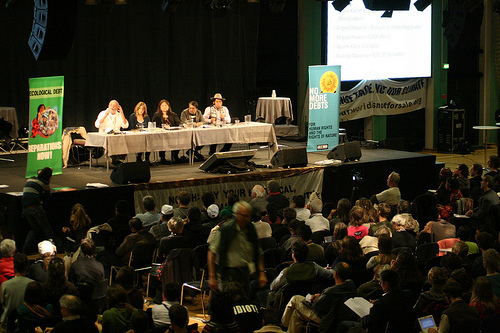
The People's Climate Forum (Klimaforum)

After Mathilde’s remarks, Klimaforum closed with a rollicking, diverse celebration, including latin, kletzmer, waltz and folk music, dance and some good laughs. One musician played an impressive solo on an oboe he’d “up-cycled” from a plastic drinking straw. A speaker warned against cynicism and its evil twin, complacency; both block action and engagement. We are all products of an unbroken chain of millions of successful ancestors, he reminded us, who, at least for a moment, felt warmly about their mates. He pointed out that we each carry within us their accumulated success in adapting, cooperating and surviving. The Danish activists who had organized and obtained funding and space for the Klimaforum handed off the effort to a new team already planning an alternative summit at COP16 in Mexico City next year. “The people must lead” they said, “We will not wait for the so-called leaders.”

An apt ending to a week’s searing contrasts between pallid UN events and the lively and productive Klimaforum. Here’s how it went for me.

For the first week and a half of COP15, I divided my time between UN events at the Bella Center and the Klimaforum. While the plenary sessions were grinding along, the UN side events offered a wealth of information and occasional inspiration: British Columbia Premier Gordon Campbell was congratulated for enacting North America’s first revenue-neutral carbon tax which led in May to his comfortable re-election. The German government detailed ambitious plans for 95% reductions in GHG emissions by 2050, pointedly including a scenario in which carbon capture and sequestration turns out not viable. And at a session on monitoring, reporting and verification (MRV) of GHG emissions, I annoyed representatives of big accounting firms by pointing out that their Herculean (and lucrative) business plans to establish baselines and monitor GHG emissions would be unnecessary under a simple upstream carbon tax.

The dynamic shifted on Wednesday. I had planned to go to Bella Center for two side events in the morning and then head to Klimaforum for an afternoon presentation on carbon taxation. I had obtained the secondary credentials the UN was using to limit the number of attendees. On the Metro to Bella Center, delegates were ordered off at the Sundby station half a mile before the center. We marched through half-a-dozen police checkpoints between dozens of idling vehicles containing barking and snarling police dogs and lines of heavily armed police. From some points, we could see and hear throngs of protestors. They had planned a symbolic meet-up uniting supportive delegates inside Bella Center with those approaching from the outside. I saw a troupe of Latina women dressed as ears of corn nearly run down in mid-dance by a police van charging at full speed. Their corn husks crunched against the van as the women dodged, barely avoiding injury.

At the final checkpoint, in line to enter Bella Center, we were serenaded by Bob Marley tunes from a PA system powered by pedalling activists. I waited with two delegates from India. Their take: “Flopenhagen.” Inside Bella Center, guards scanned my credentials. The computer rejected me, and I was brusquely escorted by police armed with Glock 45’s out to the perimeter where the Marley tunes were still playing. Meanwhile, protestors were massing outside the gates; we could hear police yelling at them.

After taking a last look at the spectacle from Sundby station, I headed back to Klimaforum, where I met Friends of the Earth delegates who had also been locked out of Bella Center. FoE had elected not to participate in the demonstrations and try to work within the UN process instead, but it and many other NGOs were excluded anyway. They felt cheated, but also appeared glad to be on the “right side” of the new line between UN insiders and outsiders.

I arrived early to the Klimaforum presentation, Carbon Taxation – A forgotten climate policy tool, by Global Utmaning (Global Challenge), an independent Swedish think-tank. I was glad to meet presenter Carl von Essen who had contacted the Carbon Tax Center about our common pursuit of transparent, predictable carbon pricing. We chatted for a few minutes; he seemed very pleased to meet a rep from CTC. Their presentation was thorough, clear and well documented, covering the advantages of direct carbon pricing in reducing emissions and encouraging alternatives. Von Essen and his colleagues pointed out in countries where carbon revenue has been used to reduce other taxes, such tax shifting has produced economic benefits.

During the Q&A, I congratulated Global Utmaning on a terrific presentation and noted the excellent attendance (150 people packed the room). I mentioned our concerns with cap-and-trade: markets, traders, offsets, lack of clear price signals… and invited listeners to a discussion that I had arranged in the nearby “meshwork” area. Eight enthusiastic participants engaged for over an hour in a very substantive discussion about carbon pricing, including nitty-gritty details like border tax adjustments and ways to make the net effects of carbon taxes income-progressive. (Carl and his colleagues had headed for the Bella Center to try to make a similar presentation there.)

Last week I also attended two Klimaforum sessions featuring prolific and influential Guardian columnist George Monbiot. He decried governments’ focus on increasing supplies of alternative energy rather than directly reducing demand for fossil fuel energy. He’s especially critical of Canada’s plans to unleash the dirtiest fossil fuel: tar sands. I treated him to tea and we had a few minutes to chat. I told him we agreed on the need to reduce energy demand and mentioned our recommended tool: carbon taxes with revenue recycling. “You’re pushing on an open door,” he said encouragingly. At his session later in the week entitled: “Are you getting the climate agreement you came for?,” Monbiot mentioned climatologist Jim Hansen’s trenchant critique of cap-and-trade and called on me during a comment period. I explained some of the flaws of carbon trading and suggested a direct carbon pricing system. Later, Monbiot picked up the point, explaining that a carbon tax is a way to reduce demand for fossil fuels and put alternatives on a stronger footing. Perhaps he’ll adopt revenue-neutral carbon taxing as a future talking point. (Click here for Monbiot’s bristling valedictory from COP15.)

What does it all mean? Like so many, I came to Copenhagen with a vague hope for a “fair and binding” agreement. I now question whether that was even a good framework to begin with. “Fair” now seems to point toward an endless struggle over allocating rights to emit carbon; and “binding” to incessant legal wrangling over monitoring and enforcement. In contrast, Klimaforum showed that leadership doesn’t have to come from the top, whether the UN or our so-called leaders. And sadly, the UN showed that it won’t.

What’s a better framework? How about one major trading bloc (e.g., the European Union or the U.S.) setting a steadily-increasing carbon tax? That would create pressure for others to follow, as the carbon-taxing countries collected (and kept) the laggards’ carbon taxes for them at the border. In effect, penalize the laggards while offering a bounty of tax revenue for those that join. The only international agreement needed — if at all — would be that every country will enact a carbon fee, along with clarification of World Trade Organization rules on border tax adjustments. Nations don’t even need to agree on the same carbon tax rate, since individual countries’ rates can be harmonized at the border.

Forget targets, verification, offsets, trading… And don’t wait for the UN. Just lead: set a carbon price. The world will follow.

Photo: Flickr / Iklimicingenclik.

Sunday, October 4, 2009

Meditation with an Apple Tree (at Earthstory)

I attended Earthstory near Petersham, Massachusetts last August where I participated in a "deep ecology" workshop inspired by Joanna Macy.

Trishki facilitated a way for each of us to listen to and connect with a tree. She suggested that we go with a question. Mine was something like this: "Why do I feel anxious about the passage of time?" Trishki said, before you choose a tree to sit with, make sure it's willing.

The first tree whose power caught my imagination was a very big, old oak tree. But as I stepped closer, I saw that the tree's base was surrounded by poison ivy. I took that to be a "no." The next tree that caught my imagination was an old, (long unpruned and wild-looking) apple tree whose trunk curved upward in an appealing, reclining way that invited me to sit with my spine, my trunk, aligned with it.

That's what I did. I snuggled until my bottom, back, neck and head were held comfortably by the tree trunk and when I'd done that, I found myself looking at one of its limbs, borne down by many green apples. The tree was holding onto the soil and rocks that my legs and feet felt below, lifting water and nutrients through its trunk behind me, up, out into its fruit, before me. A caress, of sorts.

I listened. My anxiety, it seemed, was about ego. About accomplishing. About proving something. The tree suggested, "Try this: Just be for a while. I will support you. I am strong and healthy, life is abundant here."

So this is my idea of a prayer answered. I have many "gods," alive and around me. They all will speak to me if only I listen.

Thursday, July 2, 2009

Moving Toward a Greener Economy

On July 1, the Washington Post published the following letter to the editor by Greg Ebel, President and CEO of Spectra Energy Corp., which operates natural gas pipelines and gas processing, storage and distribution facilities.
The June 26 editorial "Waxman-Markey" was right to push policymakers toward a better alternative to cap-and-trade emissions policy for addressing climate change. A straightforward, predictable carbon tax would present less room for manipulation while encouraging carbon emissions reductions.

The best carbon tax would be revenue-neutral, attaching a penalty to what we want less of (carbon emissions) while encouraging what we want more of (jobs, technological innovation and efficiency). Such a fee would directly and visibly assess the true costs associated with emissions and drive behavioral change quickly.

A tax doesn't create artificial scarcity, monopolies or rents. Without the profit potential of amassing tradeable carbon permits, industries would less incentive to try to get credits for their favored but non-competitive energy sources. That would be the likely result of the cap-and-trade bill moving through Congress.

What's more, a cap-and-trade system can be gamed. The financial derivatives associated with emissions credits would be traded in a new, hugely complex, multitrillion-dollar carbon market. Instead of turning our environment over to the traders who brought the financial system to its knees, we'd be wise to develop a far simpler system for addressing carbon emissions."

GREG EBEL

Tuesday, June 16, 2009

Carbon Tax "Vastly Superior" to Cap and Trade

Economist Gary Hufbauer testified to the Senate Finance Committee this morning:
"Climate change is a serious problem that must be addressed by the United States and other countries. To reduce greenhouse gas (GHG) emissions, a carbon tax system would be vastly superior to a cap-and-trade permit system. Carbon taxes would be more transparent, more uniform across all GHG sources, raise more revenue, easier to administer, and more readily adjusted at the border. The Waxman-Markey draft legislation illustrates the enormous complexity, opacity, and rent-seeking inherent in a permit system."
If, like me, you think global scorching could become a plague of biblical proportions, it's pretty important to get the policy right. And even if you're not that concerned about the climate crisis, you might like the idea of tax reform: reducing taxes on our pay, encouraging employment while replacing the revenue with taxes on global warming pollution, discouraging energy waste and encouraging renewable energy. Unlike the 946-page Waxman-Markey bill, most people can understand that.

Why isn't Congress going for a revenue-neutral carbon tax? They seem to think we're too brow-beaten to understand that cap/trade is a hidden, volatile and regressive tax, and they're afraid we won't accept an explicit, predictable, progressive tax shift, just because it's called a "tax."

I won't be shedding any tears when the Waxman-Markey bill goes down in flames, either on the House floor or in the Senate. Then, maybe we can have a mature discussion about what Dr. Hufbauer was describing-- a system that actually works and that would lead other countries to follow.

Thursday, June 4, 2009

Magical "Caps" Make Global Warming Go Away?

All you need is a "cap" and climate change will be "all better." That's the heart-warming story that EDF, Pew and the rest of the USCAP crowd have sold to their members, the public and the House Energy & Commerce Committee. Coming Attractions: the "magical cap" fairy tale will soon be playing to the full House.

The Washington Post reported today on very heavy lobbying of the Waxman Markey climate bill. But, the Post says cap/trade advocates are not concerned about handouts of free allowances:
Supporters of the bill say its key component is an iron-clad cap on the nation's emissions that drops over time. They said it doesn't matter how allowances are distributed.

"The environmental goals depend on having a strong cap and a time horizon to encourage innovation," said Nathanial Keohane, an economist at the Environmental Defense Fund. "That's what we see in the bill."

The biggest chunk of free allowances, worth $500 billion, would go to local electricity and natural gas distribution companies, with strings to make sure the firms use them to shield consumers from higher costs. [Emphasis added.]

So the magical "iron clad" cap does it. No need to bother anyone with higher fossil fuel prices...

Fred Krupp of EDF: "You’ve heard a thousand times that the whole point is to send a price signal. The whole point is really a declining cap [for greenhouse-gas emissions]. The cap drives innovation which lowers the costs. As an environmentalist, I’d like to see the costs at the lowest level possible, because that creates the political will to keep going, or even ratchet down the cap." (Wall St. Journal, March 19)

Contrast this with what economists say: Prof. Nordhaus: "Economic participants—thousands of governments, millions of firms, billions of people, all making trillions of decisions each year—need to face realistic prices for the use of carbon if their decisions about consumption, investment, and innovation are to be appropriate... without a strong price signal, there is simply no hope for making the vast number of decisions in a remotely efficient manner... Raising the price of carbon is [thus] a necessary condition for implementing carbon policies in a way that will reach the multitude of decisions and decision makers over space, time, nations, and sectors." [Emphasis added.]

And maybe the best part of the magical cap fairy tale: no need to regulate anything and hardly any need to even to enforce anything.... and we can feed the hungry sharks on Wall Street a new market in carbon trading while we're at it.

So why don't I believe in caps? There are two ways to reduce pollution:

1) Regulation: Prohibit or limit pollution by specifying equipment or performance, for example of power plants, appliances or buildings. And then police and enforce those rules every single day. Intrusive, bureaucratic, inefficient and requires heavy enforcement.

2) Prices: Raise the cost of pollution. That can be done directly with a tax, or indirectly with a cap which (if enforced) would raise prices. A cap says: Here's the amount of pollution we're going to allow, now bid for the limited right to pollute. But if there's a way out of the cap called an "offset" then there's really no cap at all -- the price of polluting becomes the price of the cheapest offset you can find.

Here's what the cap/trade advocates say in defense of offsets:
Offsets reduce costs to the U.S. economy by allowing firms to purchase emission reductions that occur outside the cap when they are more cost-effective, just like a cap-and-trade program allows firms to purchase allowances from other capped firms that can reduce emissions more cheaply.
And here's an example from Friends of the Earth's the "Subprime Carbon" critique of offsets:
[O]ffset projects may be simply disingenuous. Perhaps the most well-known controversies relate to offset projects designed to destroy HFC-23, a chemical byproduct of refrigerant production that is more than 11,000 times more potent than carbon dioxide. Widespread reports of companies purposely creating these very powerful greenhouse gas chemicals — just to destroy them and make money off of the credits — prompted the Kyoto Conference of the Parties to take up this issue at their December 2008 meeting in Poland.
Still believe in magical caps?

How about a revenue-neutral carbon tax instead?

Friday, May 29, 2009

Prof. Nordhaus on Carbon Pricing

Economic Issues in a Designing a Global Agreement on Global Warming
William D. Nordhaus

Keynote Address Prepared for
Climate Change: Global Risks, Challenges, and Decisions
Copenhagen, Denmark
March 10-12, 2009

"...Virtually every human activity directly or indirectly involves the combustion of fossil fuels, producing emissions of carbon dioxide into the atmosphere. Emissions of carbon dioxide are externalities, i.e., social consequences that are not accounted for in the market place. They are market failures because people do not pay for the current and future costs of their emissions.

"If economics provides a single bottom line for policy, it is that we need to correct this market failure by ensuring that all people, everywhere, and for the indefinite future face a market price for the use of carbon that reflects the social costs of their activities. Economic participants—thousands of governments, millions of firms, billions of people, all making trillions of decisions each year—need to face realistic prices for the use of carbon if their decisions about consumption, investment, and innovation are to be appropriate.

"...Raising the market price of carbon provides strong incentives to reduce carbon emissions through four mechanisms. First, it provides signals to consumers about what goods and services produce high carbon emissions and should therefore be used more sparingly. Second, it provides signals to producers about which inputs (such as electricity from coal) use more carbon, and which inputs (such as electricity from wind) use less or none. It thereby induces producers to move to low-carbon technologies. Third, high carbon prices provide market signals and financial incentives to inventors and innovators to develop and introduce low-carbon products and processes which can eventually replace the current generation of carbon-intensive technologies. Finally, and most subtle of all, the use of carbon pricing economizes on the information requirements that market participants need to undertake each of these three tasks. Of course, placing a market price will not work magic. There remain many further externalities and market imperfections in energy and other markets. But without a strong price signal, there is simply no hope for making the vast number of decisions in a remotely efficient manner."

"Raising the price of carbon is a necessary condition for implementing carbon policies in a way that will reach the multitude of decisions and decision makers over space, time, nations, and sectors." (Emphasis added.)

Saturday, April 11, 2009

The Six Flaws of Cap/Trade and How to Fix Them

Can and Trade proposals, like the Waxman-Markey discussion draft released last week, generally contain six major flaws. Aw we remedy each of those flaws, we move closer to the "gold standard" -- a revenue-neutral carbon tax.

1) Upstream: Impose the cap (or tax) at the first point of sale. Easiest enforcement, fewest regulated entities, broadest effect. Only advantages to downstream cap or tax is lack of transparency (hide the price). Price signal will be passed down the chain of distribution anyway.

2) 100% Auction. Some cap/trade proposals (Waxman-Markey leaves this unspecified) would give allowances (pollution permits) to utilities and other large polluters in the hope that this would prevent them from passing on costs to consumers. But because those free allowances have value, utilities can be expected to charge market rates for them. This is what happened in the EU when they gave free allowances to utilities. (Like your grandmother leaving you her house. Just because you got it free doesn't mean you rent it for nothing.)

Obama has supported both of the first two fixes -- big improvements over the Lieberman-Warner bill of last year. Recent reports suggest that the Administration is considering concessions on its "100% auction" position.

3) Revenue-Neutral: "Recycle" the proceeds from auctioning carbon permits (or taxes). Rep. Chris VanHollen has a cap and "dividend" bill that would distribute auction revenue equally to households. This eliminates the overall regressive effect of a carbon tax. People who use less than average amounts of fossil fuel would get "dividends" larger than their increased fuel costs. But everyone would feel the price pull to conserve and switch to cleaner energy. NASA climate scientist, Dr. Jim Hansen favors this "dividend" approach because it's very explicit and builds political support for the program. "Tax carbon, pay people" he says.

Another option is to use auction or tax proceeds to reduce payroll taxes. Because payroll taxes are even more regresssive than a carbon tax, the net effect of a carbon tax offset by a reduction in payroll taxes is a progressive tax shift. That is, middle and low income households come out ahead. That's the approach Rep. John Larson's bill uses. Cutting payroll taxes has the added advantage of stimulating employment.

Note that in both instances, the payment isn't linked to carbon use, so the tax encourages everyone to reduce carbon use, but below average carbon users would get more back in either dividend or payroll tax reduction than their increase in fossil fuel costs.

4) No offsets. Offsets are a way for polluters to pay someone else to make reductions. If those reductions come cheaper than making their own reductions, that means we get the same net reductions at lower cost. Offsets can be a way to fund important forestry and agricultural activities that sequester carbon. But Friends of the Earth now opposes all offsets because they are extremely difficult to verify. It's difficult to establish that a project would not have been done without the offset funding. FoE is concerned about the potential for "subprime carbon" offsets infecting the whole market in the same way subprime mortgages infected the world's financial system. Greenpeace criticized Waxman's inclusion of about 1/3 of total allowances as offsets. With access to so many cheap offsets, U.S. firms would have little need or incentive to reduce emissions for decades as cheap offsets siphon off funds needed for investment in carbon reduction infrastructure here.

Even with those four "fixes," there's still a very big problem of price volatility which can discourage needed investment in alternative energy and efficiency upgrades. When investors can't predict their return on investment, they tend to choose other, more predictable investments.

5) Price Floor. Establish a minimum allowance price. If prices go too low, there's no incentive to conserve or invest in alternative energy. That's what's now happening in the EU-- low allowance prices are discouraging green investment. A floor would mean the government would have to buy allowances at that pre-determined minimum price in the event of over-supply. Similar to the way currency is managed. The Fed buys dollars when the exchange rate gets too low. A floor would assure a minimal return on green investment.

6) Price Ceiling. Establish a maximum price to avoid crashing the economy with a price spike, for example if weather or high levels of economic activity drive up carbon permit prices. Government would have to sell additional allowances at that ceiling price. This would eliminate the much touted "emissions certainty" of a cap but would prevent political upheaval in the event of a price spike.

Other ways to manage volatility include banking and borrowing of allowances.

To the extent that the floor and ceiling converge on a single price (high floor, low ceiling) and with the other 4 fixes in place, you have a revenue-neutral carbon tax. In my view, each of those six flaws could prove fatal to a cap/trade system. From what I can tell, the Waxman-Markey proposal carries all six flaws.

Monday, April 6, 2009

Rep. Inglis Engages Climate Skeptics: Tax CO2, Not Work.

Who'd have expected a Republican from South Carolina to emerge as one of the clearest voices for effective climate policy? After a trip to Antarctica where scientists showed him ice cores that record the jump in CO2 levels now warming the Earth, Congressman Bob Inglis (R-SC) is convinced: "The evidence is compelling: Global Warming is a real, human-caused problem."

Inglis addresses skeptics with a science experiment:

“This is an egg... from the grocery store that’s been sitting there in some vinegar. Vinegar, as you remember from high school science, is an acid, and when it encounters the calcium on this egg, the calcium gets dissolved by the acid of the vinegar. This is essentially the problem with carbon dioxide levels rising in the atmosphere and the ocean being a sink for that carbon dioxide.

“...CO2 levels in the atmosphere are causing the ocean to become more acidic, and potentially dissolve the shells of the calcium based plankton. We would open a hole in the bottom of the food chain, and the result would be a very serious impact in human life on this planet.

“Unlike the models which really are very complicated, this is really a very simple chemical equation, and it will happen any time you have calcium coming in contact with an acid. So it’s more certain and something that therefore should cause us to act.

Inglis points out that we can take action without hurting ourselves. Now, we dump CO2 into the air as a free good. If we price it, and use the money to reduce other taxes we can gain in three ways. Less pollution, more jobs and better national security.

He explains, "Start with a tax reduction, that’s something conservatives can warm to, and make it a payroll tax reduction, something liberals are excited about... Reduce the taxes on payroll, and then in equal amount, apply a tax on carbon dioxide, so there’s no additional take to the government. There’s no tax increase there, it’s reducing one tax, and imposing a tax on something different. It’s reducing taxes on something we want more of which is Labor, Industry and income, and imposing a tax on something we want less of, which is carbon dioxide.

“If we do that, and then apply that mixture to imported goods as well as domestically produced goods, so we’re not simply exporting jobs and exporting the problem, what we can do is change the economics, so that incumbent technologies no longer have a free good in the air, and a free pass on the national security implications of that product. If you internalize those externals, attach those external costs to the products - to the fossil fuels - then the competing technology has a chance to win.

“[W]e can do for energy what Microsoft and Apple did for the PC and the internet. We can break through to a future that’s not dependent on fossil fuels, and that uses newer, cleaner, job-creating fuels that also improve the national security of the United States. It really is the triple play of this American century... improve the national security of the United States, create jobs and clean up the air."

See the full report at Congressman Bob Inglis: How to Engage Republicans, even Skeptics, on Carbon Legislation and Inglis' NY Times op-ed with economist Arthur Laffer, An Emissions Plan Conservatives Could Warm To.

Inglis isn't the only one who's getting the idea. The House Ways & Means Committee is catching on, too: see Ways & Means Weighs Bypassing Trading, Going Straight for Carbon Price.

Thursday, February 26, 2009

Dr. Hansen Warns Congress: Climate Chaos Ahead! Tax Carbon to Spur Clean Energy Revolution

Yesterday, I cycled over to the Longworth House Office building to meet my former EPA colleague, Julie Simpson, who's on a fellowship to Rep. Moran's office focusing on environmental issues. Together, we heard NASA's lead climate scientist Dr. James Hansen deliver fearsome news: our burning of fossil fuel is pushing Earth's climate into instablilty. As I reported at the Carbon Tax Center site, Dr. Hansen strongly advocated a gradually-increasing revenue-neutral carbon tax to spur a clean technology revolution. He recommends that all carbon tax revenue be directly distributed in equal "dividends" to individuals.

After the hearing, Julie and I headed downstairs for lunch, and were thrilled to find ourselves in line with Dr. Hansen and his sister. After asking, we joined them for lunch. Quite an honor to "break bread" with the world's leading climate scientist who's repeatedly stood up to those seeking to ignore or silence him. I asked Dr. Hansen's opinion of "clean coal," sharing my concerns about the vast additional coal energy needed to separate CO2 from hot flue gas and sequester it deep in the ground. Dr. Hansen is a quiet, calm professorial type, but his answer was forceful and unequivocal: "There is no such thing as clean coal, and there never will be."

Hansen will lead a peaceful protest this Monday at the U.S. Capitol power plant to call on Congress to phase out coal power, a leading cause of global warming. See Capitol Climate Action for his short video calling for action.

Staff on Capitol Hill are working long hours on a whole range of emergencies, including climate legislation. Many members of Congress are finally taking the climate threat seriously. But many still deny or minimize the crisis, and many others still seem to think "cap-and-trade" with its alluring name and hiding of the price, will magically do the trick.

Much more work ahead.

Thursday, February 19, 2009

Climate for Change in Washington, DC (or "Elasticity of Thermal Underwear")

Grey, chilly February morning. Sparrows, crows at my feeder -- pushing, squawking, scolding for perches above the grain trough. Competition eclipses nutrition. Or is it just sport? I recognize the game.

Slept well: cool air, warm blankets. Heat's off in my DC row house-- buffeted by a foot of attic insulation, neighbors, thick walls. Thermal underwear tops my list of global warming reduction technologies. Pays for itself daily. Feeling bouyed, reflective after two days of meetings between carbon tax coalition and Capitol Hill staff.

Our coalition is growing, bonding: Carbon Tax Center, Climate Crisis Coalition, Friends of the Earth, Friends Committee on National Legislation, Get America Working, Climate Policy Center. Dedicated, passionate local activists from adjacent Maryland and Virginia districts.

"Revenue-Neutral Carbon Tax" seems less quixotic now. Smart, urbane Hill staff ask incisive questions about pricing carbon emisssions, adjusting rates to meet scientific standards. We, carbon tax advocates are no longer the "lepers" of the environmental movement. Questions are about "how", not "why" to price CO2 emissions. About rates, revenue-recycling, payroll tax reductions, price elasticity, expectations, energy efficiency and technology substitution. We're way behind, the hour is very late, but the "denier in chief" has left town. Not a second too soon.

Debated "tax vs. cap" on Progressive Democrats of America's climate activists' conference call last evening. About 50 participants. Thoughtful questions. The word is getting out: Cap-and-trade is a hidden, volatile, regressive tax to fund favorite projects including the thermodynamically questionable "carbon capture and sequestration" a.k.a., "clean coal."

A carbon tax can be simple, quickly-implemented and fair. Most importantly, transparent prices are effective. Can't say who "won" the debate. My rival, NRDC's Dan Lashof is no lightweight. Listeners' questions made me think we're toe to toe with what was presumptive winner. Complex stuff. Someone asked how cap-and-trade can be internationalized. My answer: It's a nightmare. And India and China won't do it. Carbon tax is straightforward -- we tax other countries' goods on import. If they enact their own carbon taxes, they keep the revenue. India and China might do that.

Long list of follow-up items. Call my sweetie. Take clothes off the line. Pay the electric bill. Global warming, Congress, prices, clothespins. Advocate exponentially, act arithmetically?

Thursday, October 9, 2008

Ingrid Jackson asks candidates THE CLIMATE QUESTION

EGROM FALCUOR!

Bravo! to Ingrid Jackson for speaking truth to power at Tuesday's Presidential "debate." After pointing out how fast Congress moved in the face of an economic crisis, Ingrid asked the candidates what they would do in their first two years to address the climate crisis and create green jobs. Interviewed afterwards, she said neither candidate responded with the sense of urgency she feels. Ingrid, I'm with you!

Obama promotes "clean" coal, technically "carbon capture and sequestration" or CCS. The idea: "capture" the CO2 released from burning coal, then pump it into empty gas formations deep in the Earth where we hope it will stay-- forever. If these processes are even possible on a large scale, we know from thermodynamic calculations that they'll require vast amounts of energy. (Think about separating gases and about pumping them long distances and deep into the Earth or the oceans.) Estimates by the Nobel-prize winning IPCC suggest that CCS would require 30 - 60% more energy than otherwise would be needed to make electricity. The additional energy and capital cost of CCS equipment would push electricity costs up roughly 80 - 120%. But right now, wind power is available to consumers in many states for about 15% more than dirty coal power. Here in DC, it's called "Power Choice." So wind is already cheaper than "clean" coal is expected to be for electricity generation. And the cost of wind energy should decline as we scale up. Conversely, capturing and sequestering carbon from "clean" coal is likely to become more costly (both in dollars and energy) as the easy and close places to store CO2 underground are filled up and we have to pump waste CO2 further and deeper.

McCain advocates drilling and nuclear. (Is nuclear better than Bush, Palin and Homer Simpson's "Nuke-you-lar"? Sorry, couldn't resist.) Nobody would operate a nuclear power plant in the US without insurance. And no insurance company writes policies to cover the huge damages of a nuclear disaster, at least not at prices utilities could profitably afford. So Congress committed our tax dollars to insure the owners of nukes. The nuclear power industry would not exist if it had to buy adequate insurance at market prices. The risk is too vast. If the insurance companies won't cover nuclear, why are we willing to take such risks? Not convinced? Read about the Chernobyl nuclear disaster.

Hats off to Ingrid. Too bad our choice is between a) Obama's "clean coal": mountaintop removal, toxic air and water with staggering costs and b) McCain's nuclear: uranium mining and processing, radioactive air and water, with the risk of accidents like Chernobyl and the intractable problem of nuclear waste disposal for a few million years. How about c) wind, solar , geothermal and conservation, please? How about pricing carbon pollution to push everyone -- the entire energy market -- towards conservation, renewables and yes, Ingrid, green jobs?

Why do candidates avoid mentioning conservation? The U.S. wastes about half the fuel we burn. What about insulating our houses, turning off lights, turning down thermostats and avoiding aggressive driving? What about flying a lot less? (A 4,000 mile round-trip produces approximately eight tons in CO2-equivalent gases per passenger. Roughly the same amount of CO2 produced yearly, per person, to power the average American car and supply heat and electricity for the average home.)

When will major party candidates level with us? As environmental scientist, ethicist and population activist Paul Erlich points out, it's time to re-think what it means to have a good life. Can't we be happier with more love, more learning, more community, and less waste, less stuff, less travel, less of everything we've been told to by advertising to buy. And what about the old idea we should only buy what we have money for?

Ingrid may be too young to have heard John Lennon's song "Gimme Some Truth" but that's what she was very earnestly asking for. We didn't hear much truth about the climate crisis in the debate, but maybe her question will remind us to keep asking. We're running out of time.

Tuesday, September 23, 2008

"Fierce Urgency" of Climate Crisis compels Carbon Tax

Effective climate policy finally got a hearing on Capitol Hill last week.

The "fierce urgency" of the climate crisis compels effective action, warned Rep. John Larson (D-CT) at Thursday’s House Ways and Means Committee’s packed hearing on climate change revenue measures. Hurricane Ike’s devastation of coastal Texas imparted deeper meaning to Martin Luther King’s phrase. Witnesses pointed to storm-related damage as one of many ways in which failure to reduce the greenhouse gas emissions that drive global warming will destroy ecosystems and economies alike.

New York Mayor Bloomberg kicked off a day of testimony calling for revenue-neutral carbon tax as the most effective and transparent way to "use capitalism" to create the incentives for everyone to reduce fossil fuel use and for development and implementation of low-carbon alternatives.

Earlier in the week, a panel of politically-diverse economists recommended distributing revenue from either a cap-and-trade auction or a carbon tax to individuals rather than doling out the funds (or equivalent in pollution permits) to energy firms.

The focus on effective policy rather than the tired refrain of denial and delay felt refreshing, even inspiring. Expert panels discussed potentially effective measures like a carbon tax with a direct dividend; the discussion has moved beyond clumsy and ineffectual cap-and-trade measures that have dominated for years and which have produced no greenhouse gas reductions in Europe.

The deniers and delayers got their appearance; Heritage Foundation's David Kreutzer asserted that nothing the U.S. could do would matter and that climate legislation is too costly. Maybe that's progress; industry shills seem to have moved from denying the climate crisis to quibbling about the cost. (Gargantuan storms like Katrina and Ike are hard to ignore so they're changing the subject to money.)

The conservative / industry line on global warming closely tracks their half-century old script on smoking and lung cancer. No surprise, it's the same crowd. Their game plan:

1) Deny. "Smoking doesn't cause cancer." ("Global warming is a hoax.")

2) Generate controversy: "You can't prove smoking causes lung cancer." ("You can't prove global warming is real.")

3) Blame the victim. "It's your fault, there are warnings on the label — why did you start? You could have quit." ("It's your fault, you're addicted to oil, you should be "energy independent".)

4) Assert that it's impossibile to do anything. "Banning or restricting smoking wouldn't matter, people would smoke anyway." ("Pricing or regulating greenhouse gas emissions and developing alternatives won't matter, the Chinese and Indians will burn coal anyway.")

5) Argue cost-benefit; assert that it's too expensive to do anything. "Tobacco is very profitable. Regulation costs more than our profits and would put poor tobacco farmers out of business. ("Fossil fuels are necessary for economic growth, serious action to reduce their use would destroy our economy and hurt poor people.")

6) Bankruptcy. (Coming attractions.) "We're bankrupt and can't pay for the harm we've caused." (Bankruptcy is depolyed only after executives and the savvy "insider" shareholders have taken their money out of the company or out of the country. It's standard strategy in Superfund cases -- the polluters delay while they move their assests, then leave taxpayers stuck with the cleanup bills.)

Science will prevail, but climate change grows exponentially and irreversibly, so if industry shills like Heritage can stall for a few more years, it will be too late to save much of civilization or Earth's biodiversity.

Socrates said "There is no evil but ignorance." Heritage is doing its best to keep us in the dark. The Committee gave them their say, but maybe their script is finally wearing out.

It's not a question of whether the U.S. acts alone, it's whether the world's largest economy takes the lead in pricing carbon emissions. As Dr. Frank Ackerman of the Stockholm Environment Institute put it, “If the U.S. leads, the world will follow, but if we don’t, the worst consequences” can be expected.

Monday, August 4, 2008

Like The“Boy Named Sue,” Carbon Tax Advocates Battle Bias Against Name

In his hit "A Boy Named Sue," Johnny Cash sang of a boy whose father named him “Sue” and left him to make his way in the world. “Sue” grows up seeking revenge on his papa. They finally meet in a barroom brawl, and Sue gains the upper hand. But he spares the life of the man who saddled him with a girl’s name after his dad explains, “I knew you'd have to get tough or die. And it's the name that helped to make you strong."

Carbon tax advocates understand how "Sue" felt. We’re often ignored or ridiculed, and have to fight to be taken seriously. “Life ain’t easy for a boy named Sue.”

While carbon taxes are ignored, life has been easy for the competing carbon-reduction scheme known as cap-and-trade. Big Green groups like Environmental Defense and the Natural Resources Defense Council have strongly backed cap-and-trade, as have some major corporations seeking to promote their green credentials and secure prime seats at the bargaining table. Politicians seem loathe to mention carbon taxes. John McCain and Barack Obama (as well as Hillary Clinton) support a carbon cap-and-trade system. Few members of Congress dare to support a carbon tax.

Yet economists across the political spectrum are virtually unanimous: a revenue-neutral carbon tax would reduce emissions far more effectively than a cap-and-trade system. Some even suggest that cap-and-trade's complexity and volatility would cause it to fail altogether. Nevertheless, the political class insists that the public will never accept anything called a “tax.” And so, in a classic self-fulfilling prophecy, Congress hasn’t seriously entertained a carbon tax and media coverage is almost entirely focused on cap-and-trade.

Across the border, the picture is quite different. The leader of Canada’s (centrist) Liberal Party, Stéphane Dion, is advocating a carbon tax re-framed as a ”Green Shift” that would tax fossil fuels and redistribute the revenues to taxpayers by reducing other taxes and direct payments. Dion and the Liberals are taking plenty of flak for advocating a tax, but, like Johnny Cash’s “Sue,” they’re hitting back hard, pointing out that a revenue-neutral tax is not a government money grab but an effective and progressive way to nudge the economy toward a low-carbon diet. Dion’s plan would bind the government to return every dollar collected for carbon pollution to Canadians via other tax cuts, annually verified by the Auditor General. Canada’s third largest province, British Columbia, started a revenue-neutral carbon tax this July, and other provinces are considering following suit.

Cap-and-trade advocates don’t broadcast the inconvenient truth that higher fuel prices are an element of both cap-and-trade and carbon tax systems, and indeed, that a price on carbon emissions is central to any serious policy to combat global warming. Advocating a carbon tax, Canadian environmentalist David Suzuki puts it this way: “We pay $90 at ton to put garbage into landfills – yet we act as if the atmosphere is limitless and don’t pay a price for [dumping carbon into] it. That doesn’t make any sense.”

Cap-and-trade would reduce emissions — and raise prices — by gradually reducing the number of pollution permits. This would require setting up a whole new market with its own currency (auctioned, tradeable permits) and a regulatory bureaucracy dedicated to overseeing the new market and its participants. Setting up and managing such a bureaucracy is an enormously high price to pay just to avoid saying the word "tax" or having to explain a “revenue-neutral carbon tax.”

To many environmental advocates conditioned by years of “settle for what we can get” politics, advocating a policy called a tax is about as appealing as being a boy who has to explain why his name is “Sue.”

But just as the boy named Sue was tough inside, a carbon tax is straightforward and plays no favorites. The underlying idea is simple: reduce carbon emissions by imposing a comprehensive tax on coal, oil and gas where they enter the economy. The tax must be high enough and increase steeply and predictably enough to affect consumer and business expectations and behavior via the pull of price signals. As the tax pushes the cost of coal power above that of wind energy, entrepreneurs will build, and consumers will purchase power from windmills, not coal mines and coal-fired power plants. When heating bills exceed the cost of attic insulation and energy-conserving windows along with the hassle of installing them, homeowners and landlords will hire renovators instead of paying the higher fuel and utility bills. When airfares exceed the cost to build and run a network of high-speed trains, perhaps Congress will get busy and authorize it.

During the debate leading up to the defeat of the Lieberman-Warner cap-and-trade bill in June, proponents argued that a cap with auctioned permits would generate revenue just as a tax would, and that these revenues could be allocated to alternative energy projects and other "good works." But this idea has three serious flaws:

1. Congress favors powerful corporations and other big campaign donors, so unsurprisingly Lieberman-Warner would have given out the auction revenue as subsidies for ethanol, nukes, "clean coal" research, and "transition adjustments" for the same fossil fuel industries that would have paid for pollution permits

2. It's far too early in the technology race for Congress or anyone else to know which technologies will work the best for reducing greenhouse gas emissions. In contrast, a tax on carbon pollution would set the market to work on finding, developing and deploying those technologies.

3. Because poor families spend a larger fraction of their incomes on utilities and fuel, both a carbon tax and cap-and-trade would disproportionately impact lower income people unless linked to a dividend or tax shift to distribute the revenue to everyone. Rich people (who fly more, drive bigger vehicles and live in larger and multiple homes) burn far more fossil fuel than poor people, so the rich would pay most of the revenue into a carbon tax, while a dividend would spread that money equally over all income groups. The Carbon Tax Center figures that the bottom 2/5 of households would be net gainers under a carbon tax with dividend, while the middle quintile would break even and the top 2/5 would pay more carbon tax than their dividend. Under a carbon tax-and-dividend, we'd all pay higher prices for fossil fuel but we'd all get the same dividend. So those who use less than their share of fuel (lower income folks and those who learn to reduce carbon impacts) would pay out less in increased prices than they would receive in dividends. We'd be PAID to conserve the carbon recycling capacity of the atmosphere while the wasters at the top were penalized.

The bottom line: a carbon tax with dividend (or tax shift) will push everyone to reduce fossil fuel use without hammering the poor.

Unless the U.S. and other nations attach strong, clear price signals to carbon emissions, we won’t develop and implement low-carbon technologies. Instead, the world will continue to waste energy and spew carbon, and global warming will cascade into a chaotic and unmanageable avalanche. A revenue-neutral carbon tax is the right medicine for this grave condition. It would be tragic if its jarring name kept the best medicine on the shelf while the patient languished and perished.

Thursday, May 8, 2008

Great week for truth in carbon pricing

Three heartening developments:

Obama gained high ground by acknowledging the inconvenient truth: reducing fossil fuel prices in the face of climate catastrophe isn't a good idea.

British Columbia initiated a revenue-neutral carbon tax with dividend to create incentives for a more carbon-efficient economy.

Two courageous EPA enforcement attorneys exposed the manipulations and failures of cap-and-trade.

Maybe good politics and good policies are beginning to align.

Along with Al Gore and NASA's Dr. James Hansen, economists from left to right (Rob Shapiro, Bill Nordhaus to Greg Mankiw and Ken Greene) agree: pricing greenhouse gas emissions is a necessary first step in any effective effort to combat global warming. And like the EPA whistleblowers, they agree that a revenue-neutral carbon tax would work much better than cap-and-trade.

Because I'm convinced that a gradually-increasing revenue-neutral carbon fee would stimulate our entire economy towards efficiency and renewables (and create incentives for our trading partners to follow suit) I volunteer for the Carbon Tax Center.

We have much work ahead to build support for a carbon fee and dividend system, but after this week, I have hope.

Tuesday, March 18, 2008

Carbon Footprint

"Big Foot" (NEW YORKER, 2/25/08) by Michael Specter, describes the complexities of calculating the "carbon footprint" (climate impact) of various food products. Specter also described the similarly complex "cap and trade" system often discussed as a way to reduce greenhouse gas emissions.

My response, published 3/24/08:

Specter notes that we need price incentives to reduce greenhouse-gas emissions. But there’s a simpler alternative to cap and trade, which is a complex (and volatile) system. A carbon tax levied on fossil fuels as they enter the economy (through importation or extraction from the earth) would allow the prices of goods and services to reflect their carbon footprint; and a Congressional Budget Office study concluded that the net benefits of a tax could be roughly five times as high as the net benefits of an inflexible cap. Simple, fair, direct, and, perhaps most important, predictable.


James Handley

Washington, D.C.

Monday, March 10, 2008

Who will say the "T" word?

Enjoyed a delicious lunch with economist Ken Green at the (conservative) American Enterprise Institute two weeks ago. Green and his AEI colleagues published a terrific analysis: "Climate Change, Caps vs. Taxes" concluding that a carbon tax would be a "no regrets" economic policy creating a level and stable playing field. A tax would avoiding the scramble for polluting rights inherent in a "cap and trade" system and would provide incentives for everyone to reduce greenhouse gas emissions. And it would not handicap the US compared to our trading partners as a "cap" would.

While Green is most concerned about damage to the economy, I'm most concerned about run-away climate change. But we agree from both perspectives that a carbon tax would be far better than "cap and trade," the only approach most politicians and environmental groups even mention.

Last month, in "Policy Options for Reducing CO2 Emissions" the Congressional Budget Office concluded that emissions reductions under a tax would be roughly five times as high as those under inflexible cap. Incentives for innovation are one of the key benefits of pricing emissions. CBO found that a tax would create the needed incentives better and sooner than cap and trade.

Cap and trade systems are a (complex) way to create new markets to trade the right to pollute. A carbon tax is a (simple) way to use EXISTING markets to create incentives to reduce carbon emissions and to maintain the resources (rainforests, for example) to sequester carbon. Both will increase fossil fuel prices. A tax would increase fossil fuel prices predictably and gradually, emissions trading would add volatility and unpredictabilty to prices.

So why aren't the mainstream environmental groups and the politicians even talking about a carbon tax? They seem afraid we'd hang them for mentioning the "T" word.

But this "tax" is more like a user fee. When we pay our water bills, we pay for disposal and treatment of the waste water-- a sewer fee for every gallon of water we use. It reminds us not to waste water-- because there are costs of bringing the water to us, and there are costs of taking the waste away. Similarly, carbon tax (or fee) is a way to build in some of the cost of disposal of greenhouse gases into the atmosphere and would put non-fossil fuel energy sources, like wind, on a more equal footing. (A very small carbon tax would very quickly make wind cheaper than coal as a source for electricity generation.) We could use carbon tax funds to provide incentives for preservation of tropical rainforests, the biggest carbon sinks on Earth, which are now being burned to clear land for (government-subsidized) biofuels and beef.

A carbon tax can be revenue-neutral. The Carbon Tax Center suggests a "progressive tax shift" -- distributing an equal share of the carbon tax revenue to every tax payer. Those who use more than the average of fuel would pay more tax than their share (refund) payment. Those of us who use less than average would get a bonus. Everyone who spends money would have incentives to choose less carbon-intensive products and services because prices would reflect carbon footprint.

How to break the sound barrier on carbon taxes? If the Carbon Tax Center, the CBO and the AEI all agree that they'd work so much better than cap and trade, can't we at least start a political discussion about carbon taxes? The silence is deafening, and at least to me, a bit maddening.